

CX Score
CX Score is a single 0–10 score summarising the quality of the conversation experience.
You'll see it in Overview → Health, AI Impact, Louis, Topics, Use Cases, Sentiment → Quality Trends and Performance → Article Performance. The tooltip reads: "AI-computed experience score (effort + sentiment + resolution), on engaged conversations. Left early conversations have no score.".
What goes into it
The CX Score is not a mood reading. It is a weighted composite of three things:
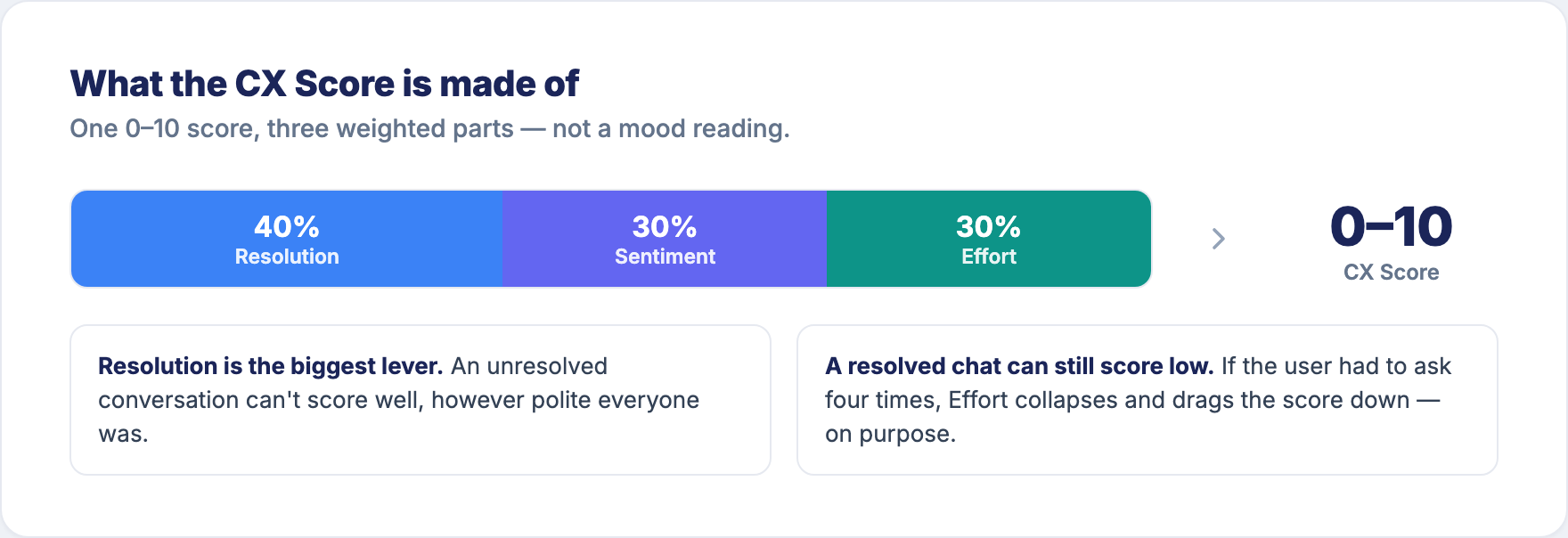
- Resolution (40%) — was the request handled?
- Sentiment (30%) — what the user's own words showed: politeness, frustration, explicit thanks or complaints.
- Effort (30%) — how hard the user had to work: how many times they had to repeat or rephrase because the bot didn't get it.
Two things follow directly from those weights:
- Resolution is the single biggest driver. An unresolved conversation cannot score well, no matter how polite everyone was. This is why AI Resolution is the metric to fix first.
- A resolved conversation can still score badly. If the user had to ask four times to get there, Effort collapses and drags the score down. That is intentional — "we got there eventually, after exhausting the user" is not a good experience, and this score says so.
The Sentiment component only counts what the user actually wrote. The evaluator is explicitly forbidden from guessing at feelings that were never expressed.
Left early conversations have no CX Score. The user left before there was anything to judge, so there is no experience to rate. The score is computed on engaged conversations only: the Resolved and Unresolved ones.
How to read it
| Score | Reading |
|---|---|
| 7 and above | Healthy |
| 5 to 7 | Mixed — worth investigating |
| Below 5 | Something is wrong on this segment |
Use it as a triage tool, not a report card. Its real value is comparative: sort your topics by CX Score and the bottom of the list tells you where your users are having the worst time. That's the list to work through — see How to improve your CX Score.
CX Score vs CSAT: what's the difference?
This is the confusion to kill first. They are two different metrics measuring two different things, and they will disagree — that's not a bug, it's information.
| CX Score | CSAT | |
|---|---|---|
| Who produces it? | The AI evaluator, reading the transcript | Your users, by clicking |
| How? | Composite: 40% resolution, 30% sentiment, 30% effort | A real thumbs up / thumbs down vote |
| Scale | 0–10 | 1–5 |
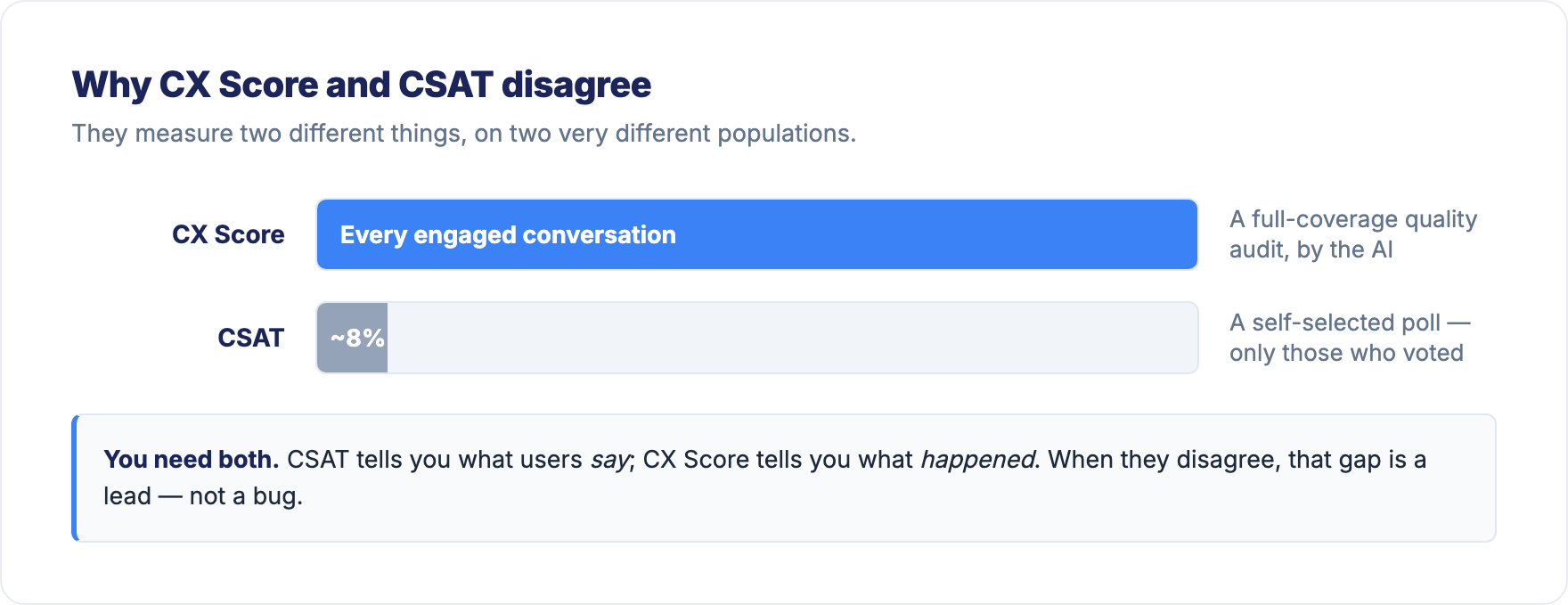
| Coverage | Every engaged conversation (Left early conversations have no score) | Only conversations where someone voted — a small minority |
| What it captures | Objective quality of the interaction | The user's declared opinion |
| Bias | The evaluator's judgement — imperfect, but applied identically to everyone | Whoever bothers to vote. In practice: the very happy and the very angry |
The CX Score is not "AI-generated CSAT"
They are not versions of the same thing. CSAT is an opinion poll with a low, self-selected response rate. CX Score is a quality audit with full coverage. You need both: CSAT tells you what users say, CX Score tells you what happened.
When they disagree, that disagreement is a lead. High CSAT with a low CX Score usually means the few people who vote are your happy ones. Low CSAT with a decent CX Score often means the bot works and something else — a policy, a price, an outage — is making people angry.
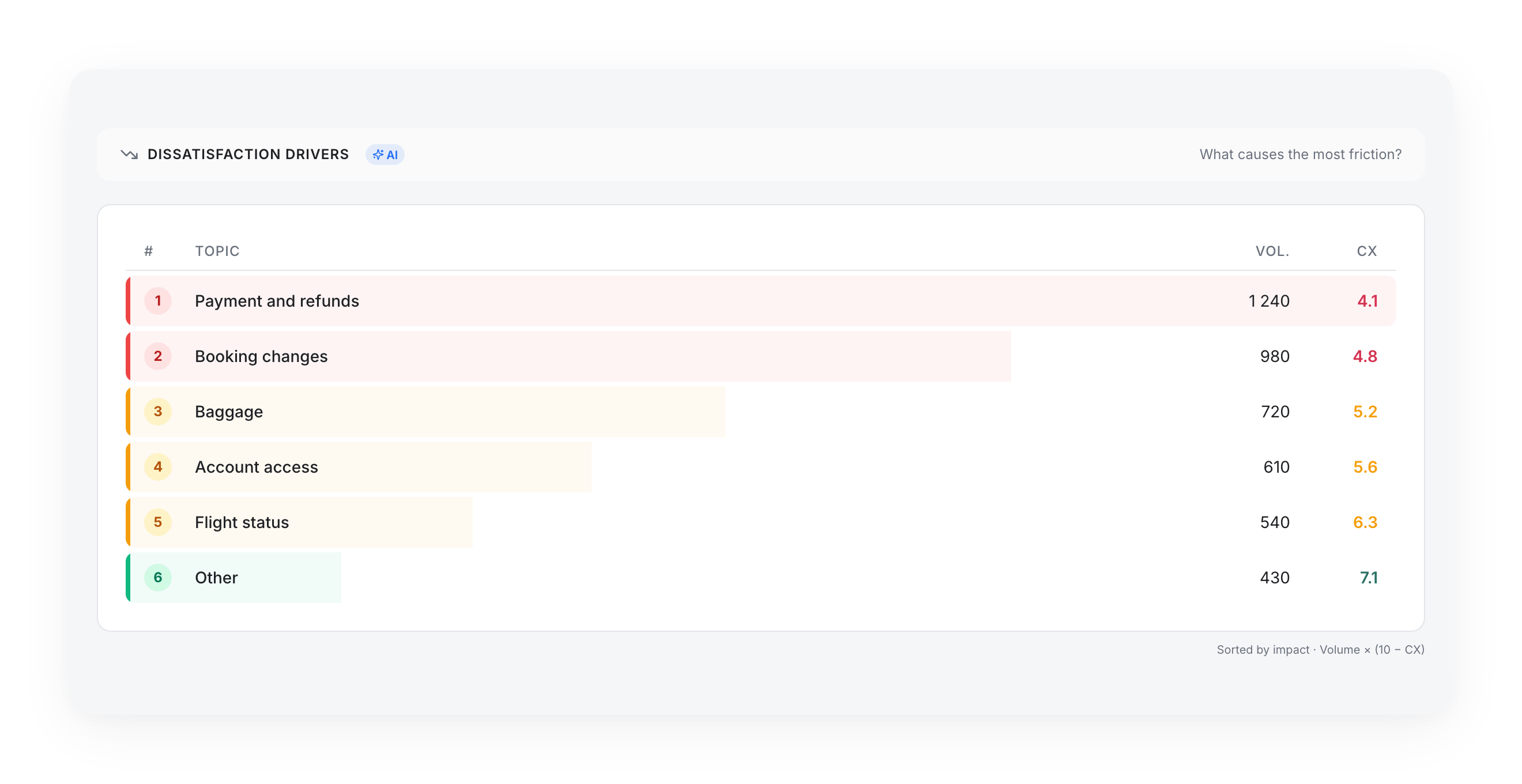
You'll find real CSAT and NPS votes, plus Dissatisfaction Drivers (sorted by Volume × (10 − CX)), on the Sentiment report.
Updated 16 days ago